The River Beds
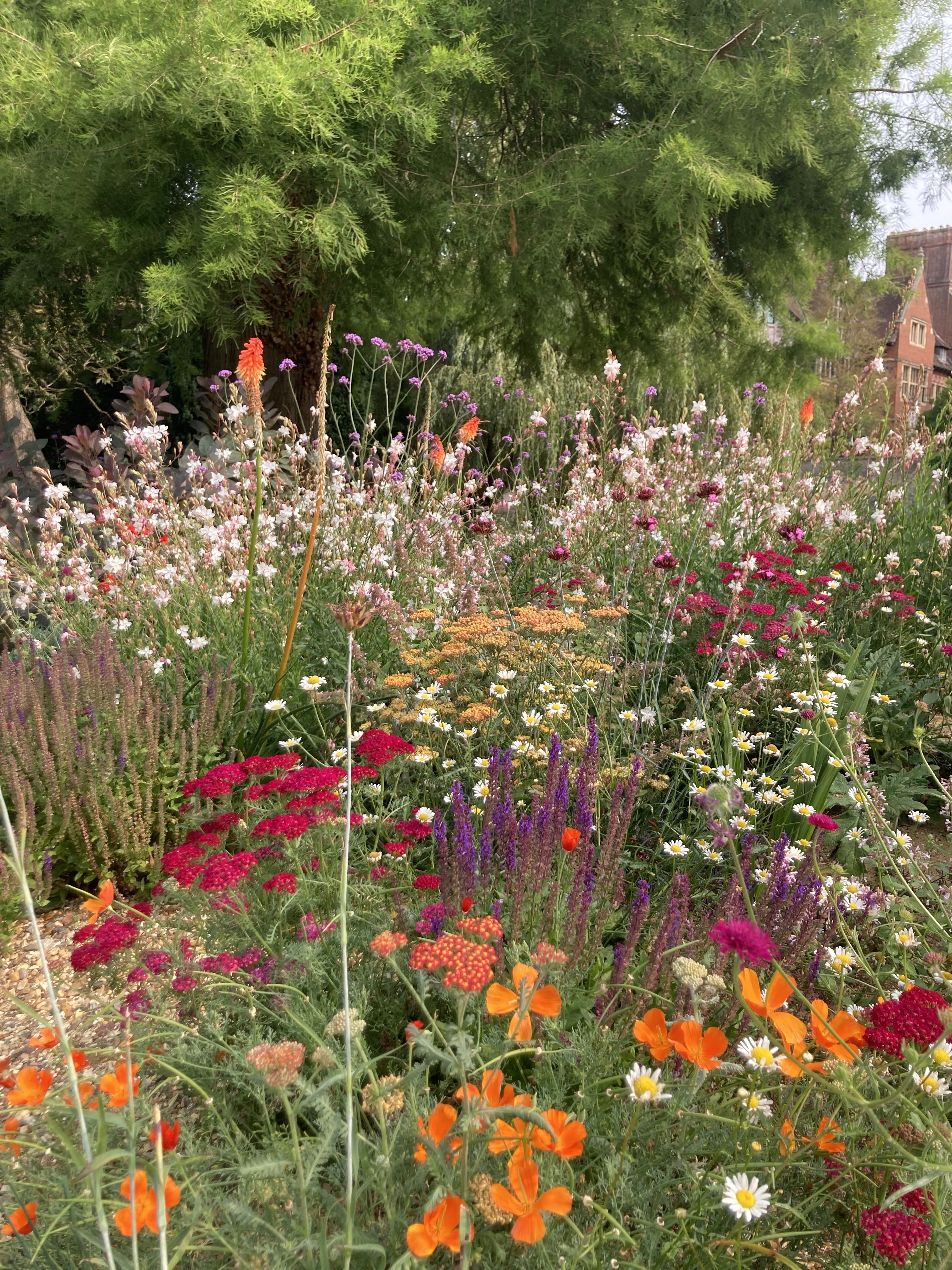


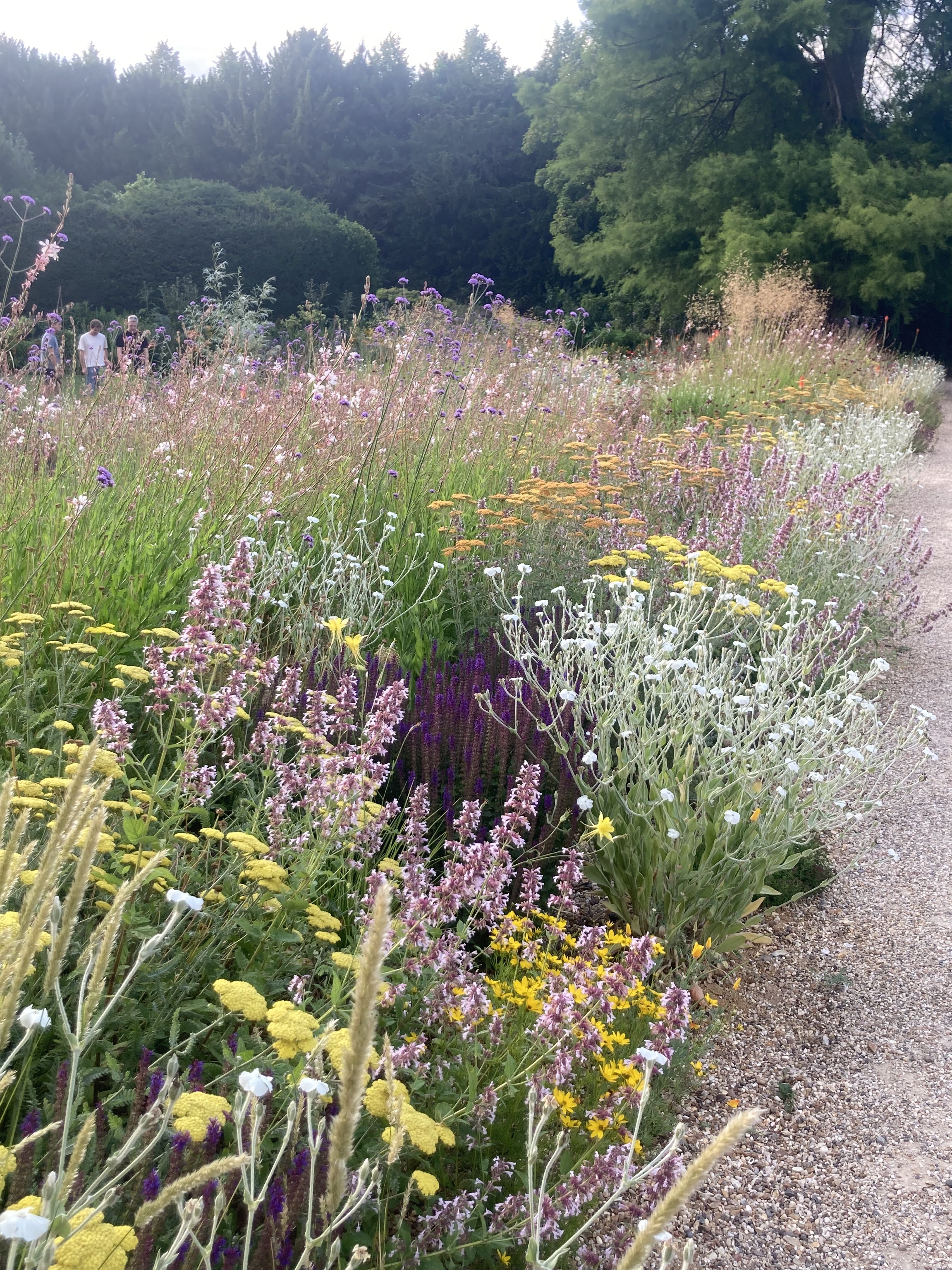
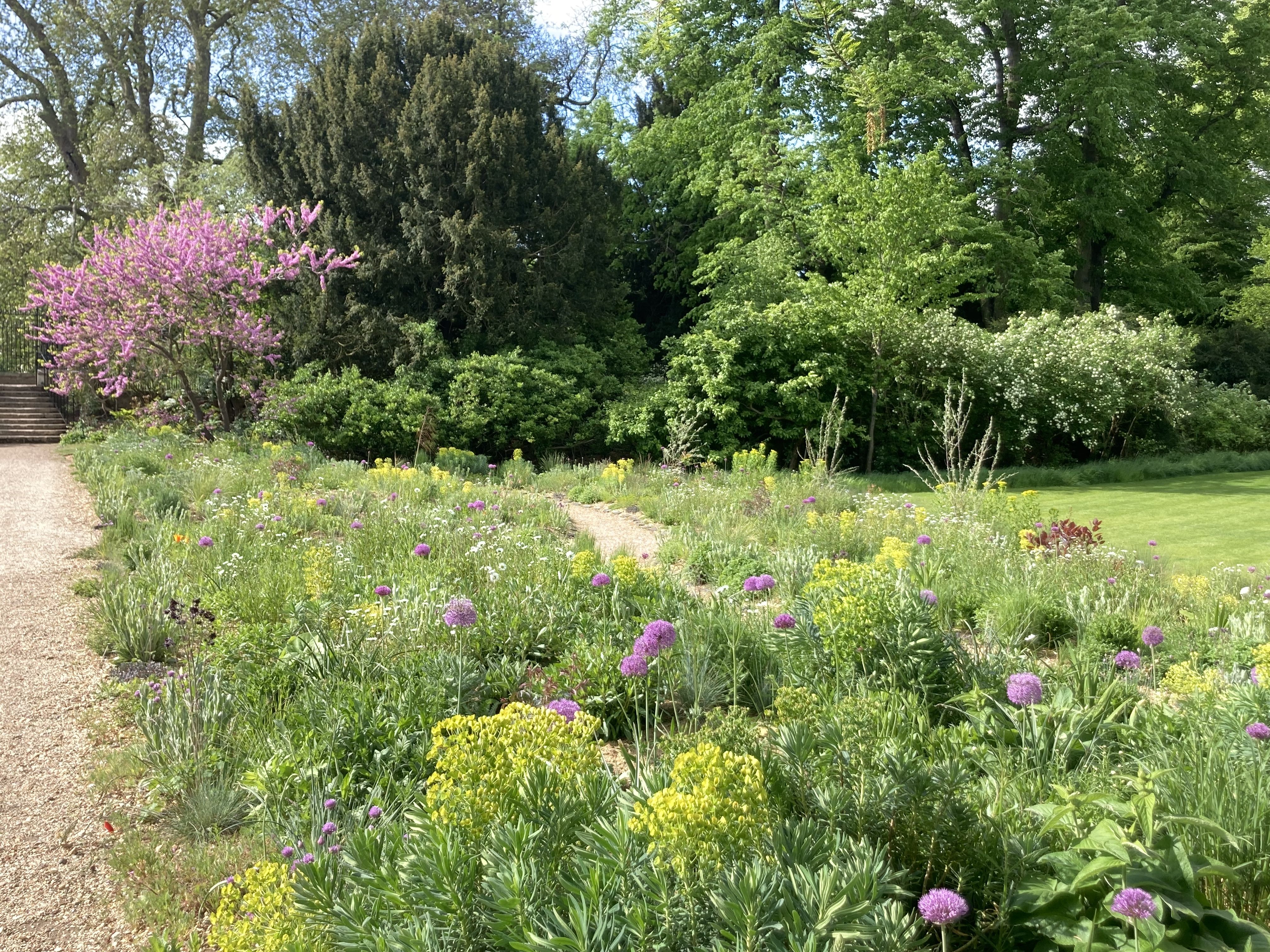
It’s been a joy and a relief to see the new riverbank planting in the Fellows’ Garden fulfil its drought-tolerant promise during this very dry summer. The plants have thrived with no additional watering, and this area, planted in May 2024 and known as the River Beds, has given us a wonderful series of changing views: from purple allium spheres emerging amid fresh clumps of green in early May, to evolving constellations of colour and bloom throughout the summer, gentle movement and airy transparency, and, as I write, the low September light picks out Aster, Rudbeckia and golden grasses.
Time is an important element in the design of the River Beds: this is a layered planting with a strong degree of seasonal succession, unfolding its own story through the year. Alongside the year-long cycle, the River Beds have another relationship to time—they belong in a narrative of garden history, and, in the age of climate emergency, changing gardening imperatives.

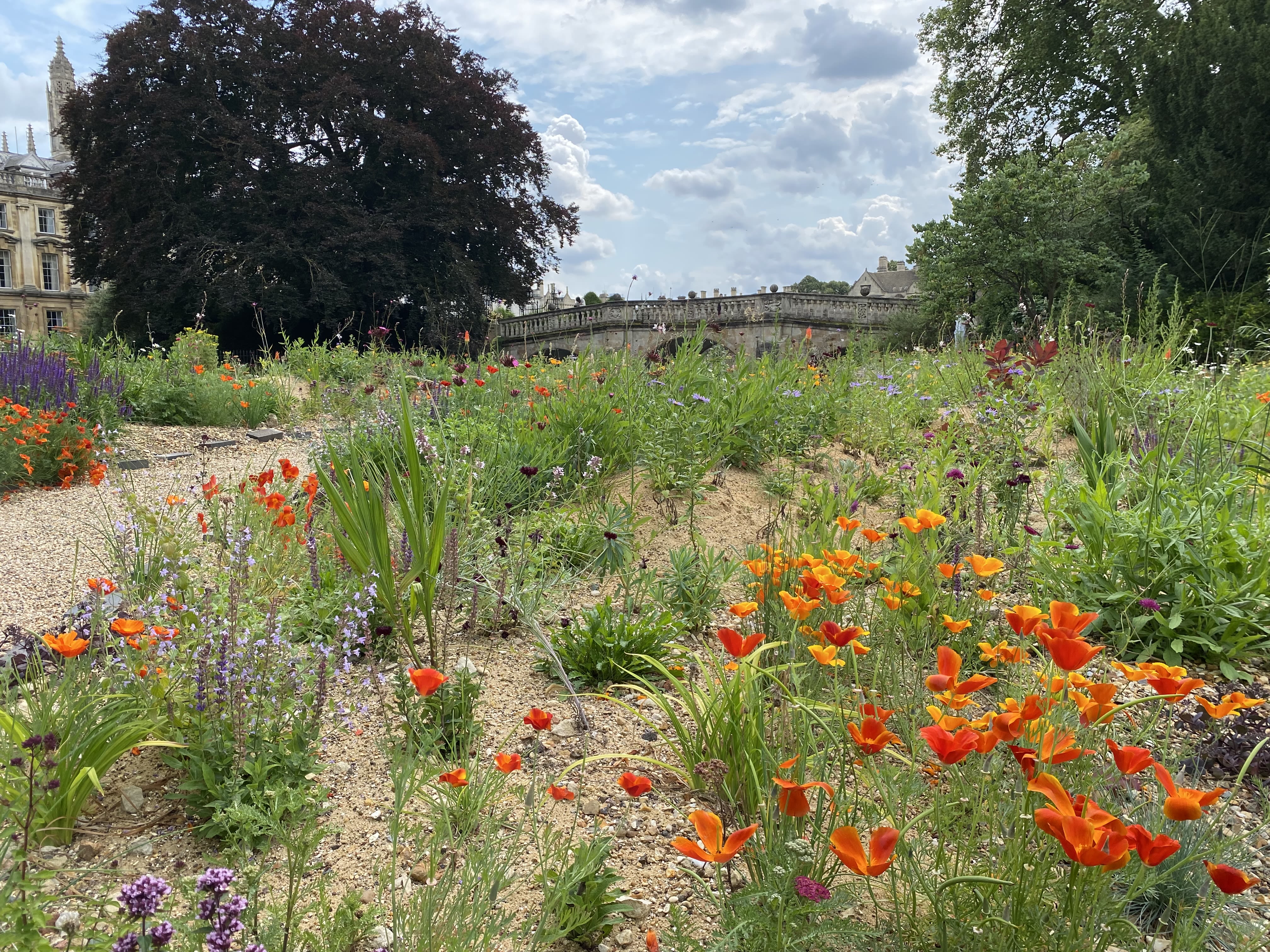
Many readers will recall the colourful yellow-orange-red summer display of the old River Beds, a legacy of Clare Fellow Nevill Willmer’s (1902-2001) plan for the garden dating from 1947. As is often noted, his use of colour in the garden was closely related to his research interests in the physiology of colour vision, but the horticultural application of ideas about the perception and combination of colours had also been promoted by one of the most important figures for British garden design, Gertrude Jekyll (1843-1932). Tastes and sensibilities shift, and from today’s perspective, such floral display feels unsustainable, given the resource-intensive process of producing bedding plants twice a year and keeping them happy and irrigated through the summer.
The new River Beds were inspired by a twenty-first-century turn: naturalistic planting. They use perennials, shrubs, and self-seeding annuals, which do not require regular replacement. All gardens possess a degree of artifice, but naturalistic planting consciously works between the two poles of the aesthetic and the ecological. Planting guided by ecological principles selects plants according to their habitat requirements and considers the community of plants in light of their sociability and life-cycles: which plants can happily live together with compatible space requirements and rhythms of annual growth to produce successional layers throughout the growing season? There’s a dynamism to such planting, with the picture shifting slightly year on year, and the processes of self-seeding and competition taking a hand in shaping things.
Time is an important element in the design of the River Beds: this is a layered planting with a strong degree of seasonal succession, unfolding its own story through the year.

Among those working in naturalistic and ecologically attuned planting, there are some influences on the design of the new River Beds that I’d like to stitch into the story of the garden at Clare, and encourage any interested readers who find themselves nearby to visit these places themselves!
The kernel of the idea for the River Beds came from an online course with Professor Nigel Dunnett from the University of Sheffield. Some of you may know Dunnett through his work at the Olympic Park in 2012. He is inspired by patterns in plant communities in the wild, patterns which we perceive as readable and beautiful. Colour may be as important to him as it was to Jekyll, but his models are drawn from nature. The course looked at his project for the Beech Gardens at the Barbican in London, which are planted in a shallow, low-nutrient substrate. This opened my eyes to the possibility of gardening without traditionally ‘good’ soil, and I realised that the River Beds area offered an opportunity to make a new kind of garden at Clare. Our riverbank had been stripped of topsoil in 2020 and covered in aggregates to make the builders’ compound and access to the temporary bridge for the Old Court construction project.
Curiosity about the use of alternative substrates led me to a bold experimenter in so-called brownfield gardening, John Little, and his remarkable garden at Hilldrop in Laindon, Essex. Hilldrop mimics an open mosaic habitat and is incredibly rich in insect species, with plants growing in crushed bathroom ceramics and sand from local road-widening projects. John subsequently came to consult on the project at Clare at Head Gardener Kate Hargreaves’ invitation and share his knowledge about using recycled construction materials in garden-making. In the shade of the temporary bridge, a hole was dug to examine what lay beneath and he reassured us that yes, things would grow…
Other, recently-made gardens which provided inspiration and encouraging examples of the potential of growing without soil are the Walled Garden at Knepp and the Dry Meadow Garden at West Dean, both in West Sussex. And we also benefitted from the great wisdom accumulated at the East of England’s most famous, long-established dry garden at Beth Chatto’s, near Colchester.

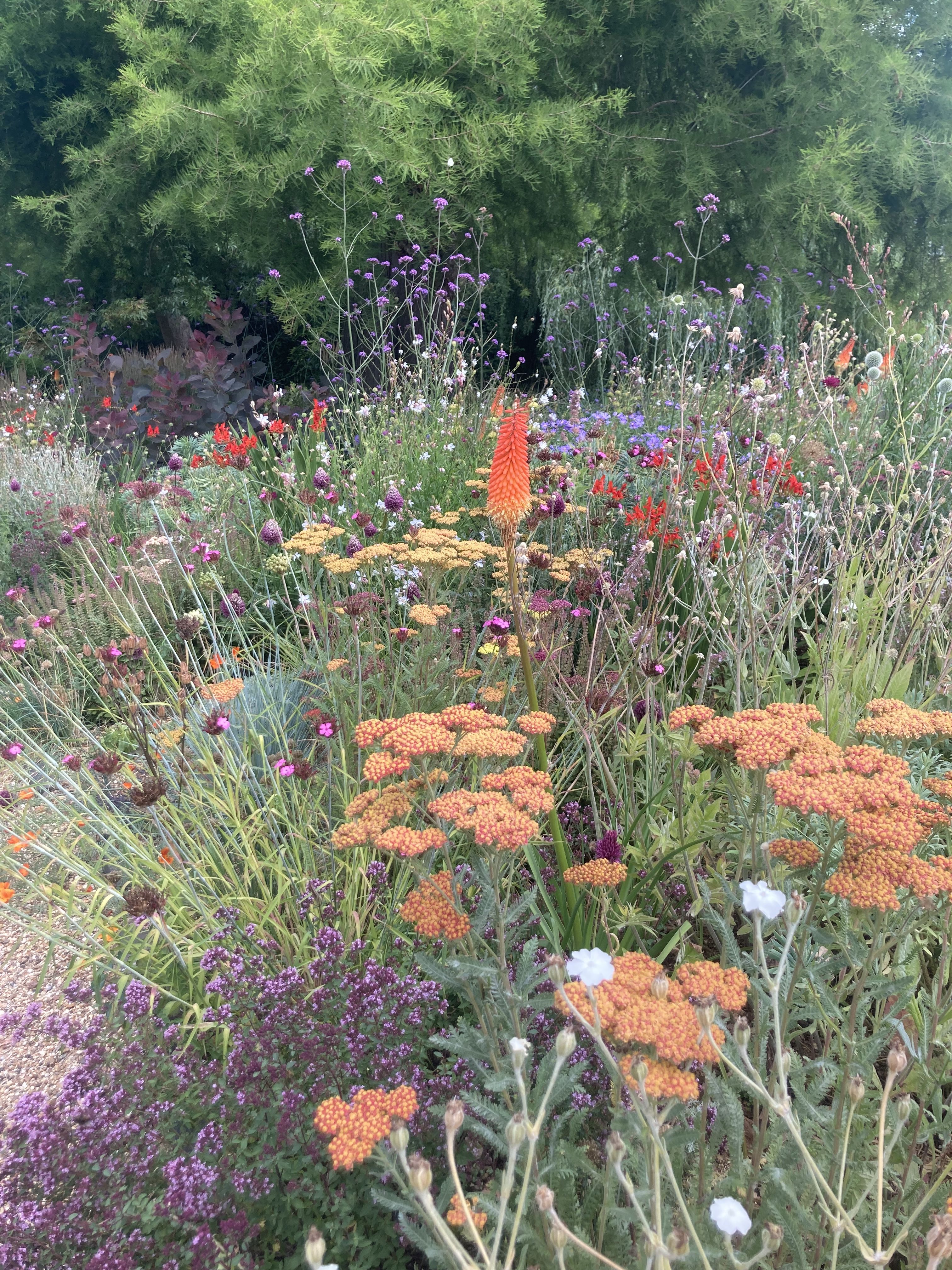
Of course, the new planting at Clare isn’t reducible to any of these points of reference; we have the particularities of our own site and setting, including the extraordinary surroundings of Clare Bridge, Old Court, the Fellows’ Garden, and borrowed views from King’s and Trinity Hall. Walk through the River Beds in high summer, from mid-June to mid-July, and you will also detect a subtle nod to the story of this area’s past—impressionistic drifts of colour, mostly created using cultivars of Achillea, in shades of yellow, orange, red. The path through the beds is an important element of the design. Willmer intended the original planting to show off its full glory when viewed from afar, whereas the new River Beds are immersive, encouraging visitors to look close-up and discover, each week perhaps, a new combination of colours and textures.
Planting into recycled materials from the College’s construction project—crushed brick, sand, gravel, aggregate—has allowed us to create a community of drought-tolerant plants that, in this free-draining medium, are spared sitting in heavy, wet soil over winter. The low-nutrient substrate also promotes resilience to drought: the plants develop strong roots and don’t produce excessive leafy growth. People often think that drought-tolerant means Mediterranean plants. We do have a few of those, but many more (such as Salvia nemorosa, Dianthus carthusianorum, Achillea millefolium, Lychnis spp.) are associated with steppe and open grassland, and have better winter hardiness than Mediterranean species. One of our late-season hero plants, beloved by pollinators and a larval food source for the mint moth, is Calamintha nepeta, a British native, rare in the wild, but found relatively local to us, on sandy and gravel ridges of north-east Essex.
The River Beds also exist in time looking forwards. The planting is not a static picture; gardens are not just designed, they are also gardened. How we garden the River Beds will chart the same path between the aesthetic and the ecological. To what extent do we let the planting’s own dynamic processes shape its future? To what extent do we edit self-seeders, manage any plants that become too dominant, replace shorter-lived perennials? Through thoughtful interventions—like not applying the same approach uniformly across the whole area at the same time (an approach that is pragmatic, too, when one is short of time!)—the gardener may even become an ecologically useful agent of disturbance, helping maintain the structural complexity across the site that benefits biodiversity.

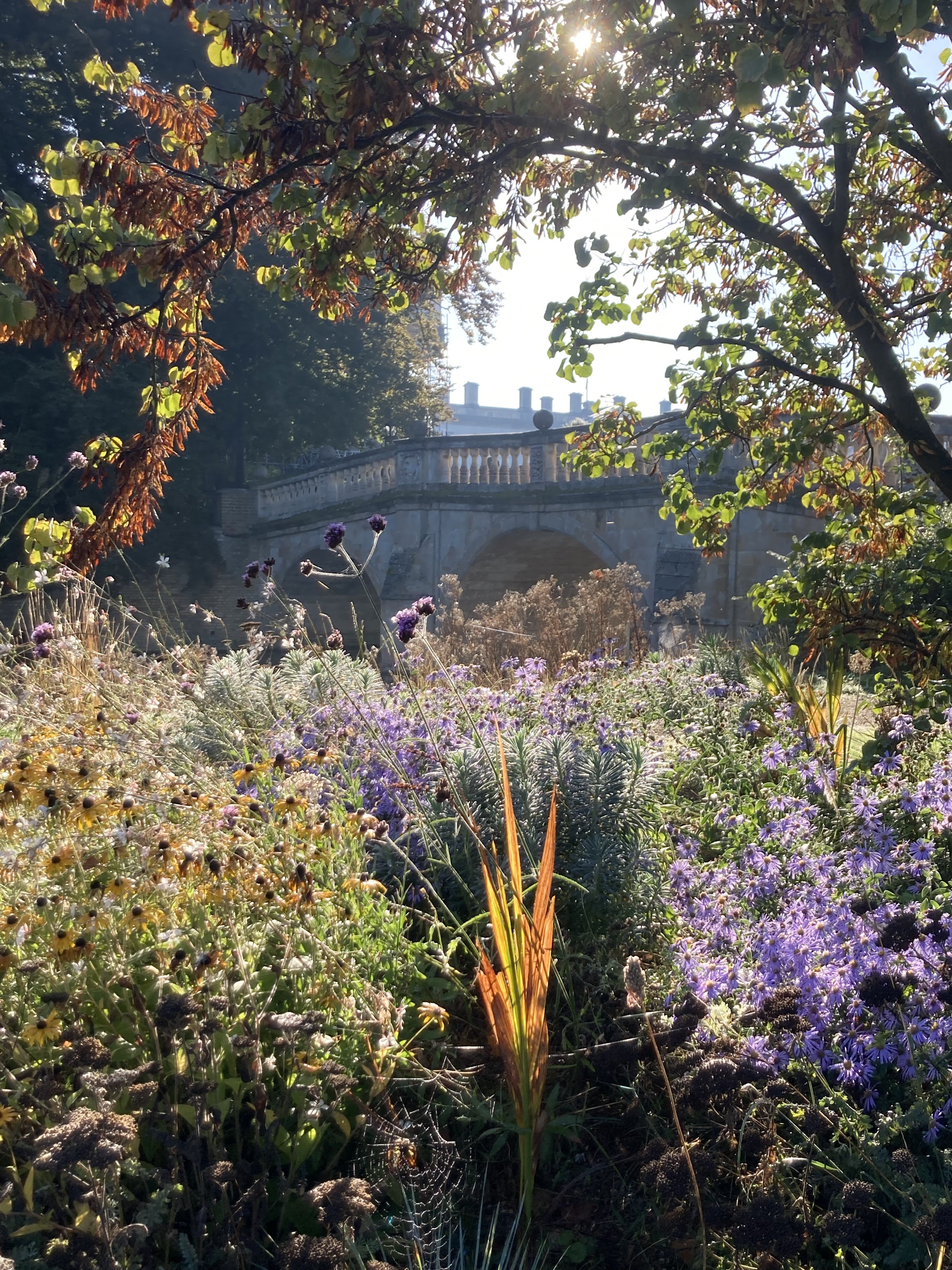
It has been a true privilege to see my design take shape on the river-bank. Happily, Kate Hargreaves recognised the potential in such a project, and managed its implementation to completion, letting no spare brick from the construction work escape uncrushed or spare bag of gravel go unsalvaged. And it’s very much to the credit of Kate and her deputy John Mears, the Gardens Committee and wider Fellowship that they were happy to embrace something new. In their own way, the River Beds tell a great story of wedding continuity and change to make a garden fit for our own time.

 Built with Shorthand