
Bringing Ancient Languages to life
Dr Charlie Weiss
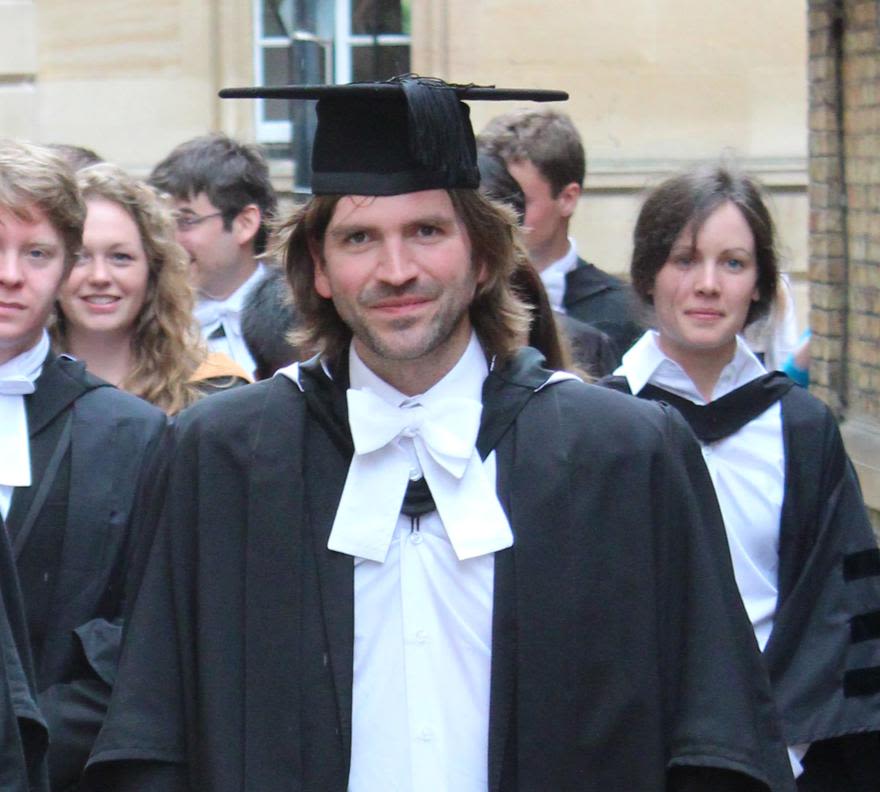

Dr Charlie Weiss, originally from Atlanta, Georgia, studied Classics at Columbia and Yale before moving to Oxford to teach Ancient Greek and Latin. In 2003 he joined Cambridge’s Faculty of Classics and became Director of Studies at Clare. He is also the College’s Praelector.
In this interview, he discusses the teaching of so-called ‘dead’ languages, the ways technology can support classical learning, and the pleasure of introducing beginners to Latin and Greek.
“I came from Oxford to my Faculty post in Classics and my Clare fellowship at the same time, in October 2003. My faculty post is called a ‘Teaching and Scholarship’ post, with the emphasis on creating teaching materials for the curriculum.
Our undergraduate programme prides itself on taking ab initio beginners quickly to competency in reading Ancient Greek and Latin texts in the original. Cambridge (and Oxford) has uniquely short terms so, for language acquisition, this is challenging for student and instructor alike, but the system works! I should add that we accept students with neither Ancient Greek nor Latin from school. When I first arrived, there were only a handful of students on this track but these students (now around 40 in number) form almost half of the incoming cohort as fewer schools teach Latin or Greek.
But this is not to say that Classics is in decline: Classical Civilisation numbers in schools are stable as are BA numbers across the UK, whether the degree is in translation or in the original languages or some combination thereof. Young people are constantly interested in the lost world of Ancient Greece and Rome – in fact people of any age find it fascinating once they encounter it.
Over time it has become clear that our requirement that students learn both Greek and Latin for a BA is one of our selling points. One reason we continue to ask students to do this is obvious but worth emphasizing: it is possible.
Learning a ‘dead’ language is in my experience more like learning how to read music or solve maths problems because there is no need for viva voce communication. To attain reading competence one simply needs to understand the patterns and the semantic system of the language, then apply it to texts. I have devised a beginner’s Latin course that can do this in fifteen days, and we use it with our beginners. Greek is notoriously more complicated: I estimate that a standard Latin verb can be put into some 250 forms, but a Greek one can be formed in at least 800 ways. But these sister languages (descending from the mother Proto-Indo-European) are actually so similar that learning Greek after learning Latin is eminently doable.
Cambridge (and Oxford) has uniquely short terms so, for language acquisition, this is challenging for student and instructor alike, but the system works!
I have always been interested in how computers can make this process more efficient for students and teachers. I frankly don’t see AI doing this anytime soon for Greek and Latin but rather some simple computer coding can help a student drill all those forms ad infinitum and I frequently use this in creating teaching materials. I am currently working on a sentence generator that takes the drudgery out of inventing plausible sentences: anyone who has used Duolingo will understand the frustration of being confronted with implausible sentences! Given enough variables the code will in fact yield interesting combinations that might not occur to an exhausted and time-constrained teacher. And the possibilities are astounding: exempli gratia if you can think of twenty adjectives that can each plausibly modify twenty nouns then you are looking at 400 good noun phrases. But take into account the five (Greek) or six (Latin) cases that words must exhibit then you are looking at 2000/2400 phrases. Add plurals and we’ve got 4000/4800—but don’t forget that Greek shows forms in the dual taking us to a breathtaking 6000 phrases from a list of twenty adjectives and twenty nouns. No human should be subjected to creating this manually, but a computer can do it easily if not beautifully. It’s especially interesting when you consider the basically unresearched rules that may govern what constitutes a plausible noun phrase anyway, to say nothing of a complete sentence.
The other great advantage of using a computer to do this kind of thing is that it is immediately ready for some kind of online experience and I try to make things available on my personal teaching website and on our Faculty Moodle. Covid was of course a disaster for education, but it did force me to see the value and power of online video. As a result, I prerecorded every Faculty lecture that I do. It’s not suited to every subject, perhaps, but for language learning it gives a student more control over complex information. Beyond revising the lecture, many of my students will come to a lecture having already watched it and some will even watch it on their laptops (silently with slides and captions of course) while I am delivering it!
But learning Greek and Latin is not simply a matter of passive osmosis. I teach all of our Clare Classicists how to imitate Plato in Greek and Cicero in Latin in preparation for the annual composition exams: these exams are optional but the intellectual value of acquiring these skills is self-evident. And these supervisions are my favourites. I myself compose a Latin elegiac couplet for each Clare Classics finalist every year to help them celebrate: if numbers are low and the Muse finds me then they might even get a Sapphic stanza!
Naturally all of this does not hamper my ability to cope with my other Clare job, but when I started to serve as the Praelector almost fifteen years ago I was so nervous and discombobulated by the choreography of the ceremony that – as many tiros do – I typed up the Latin and taped it to the interior of my mortarboard. I soon began to internalize the lovely old formulae and joined the happy band of experienced Praelectors who revel in the errors of others. I thought I had seen and heard everything until recently when (absit omen) I witnessed a fellow Praelector fall over when attempting to prevent a student from falling over! But the real fun of the job is meeting the proud families who come from all over the world and seeing first-hand the less visible threads that bind the College.

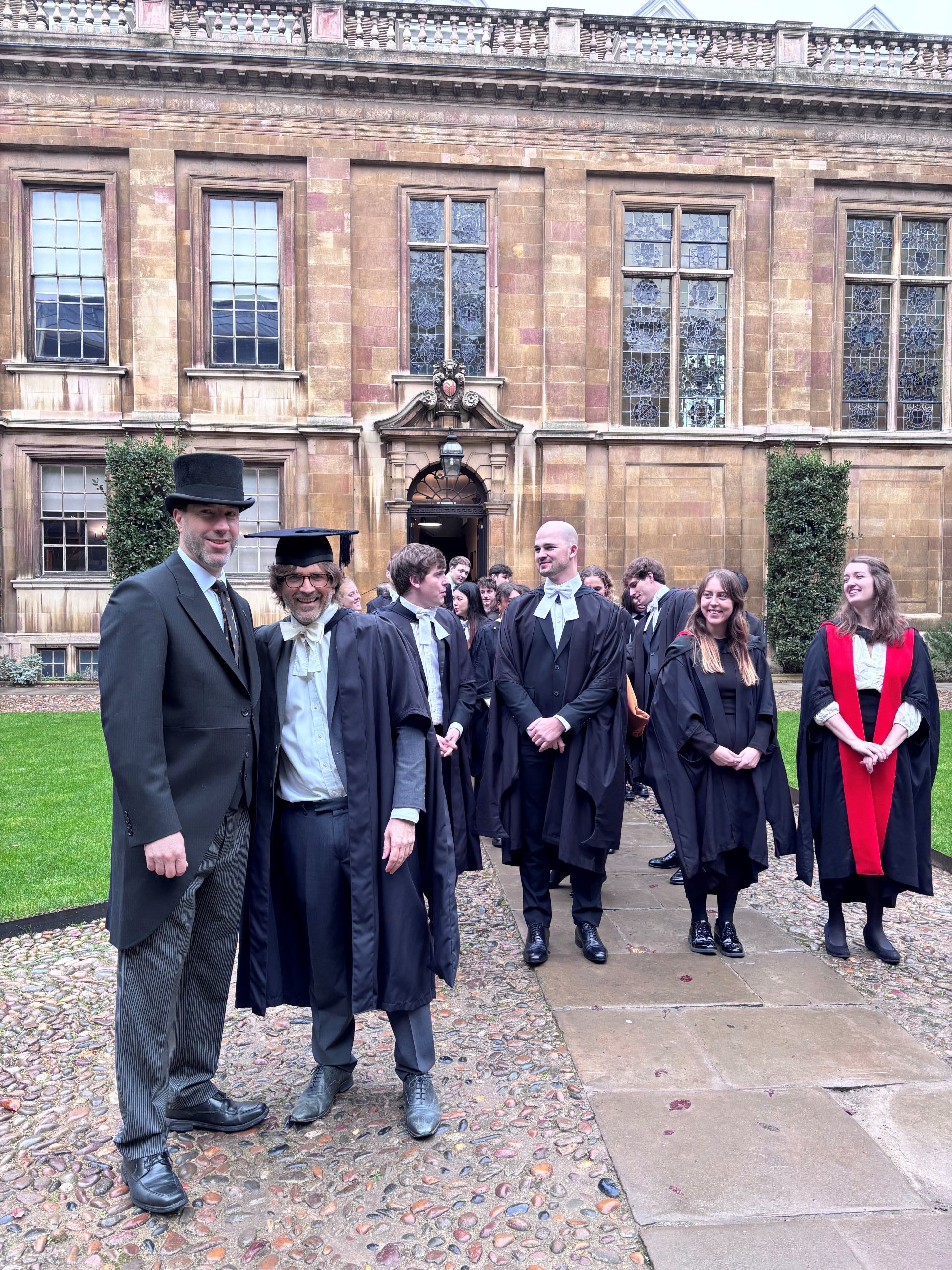
2024 Graduation
2024 Graduation

 Built with Shorthand