
Graduate Research at Clare
Clare’s postgraduate community carries out research in a wide variety of academic disciplines. Here, five postgraduate students give us brief summaries of their areas of research.


Jona Nagerl (2024)
PhD in Applied Mathematics /Theoretical Physics
Originally from Munich, Germany, Jona studied mathematics and physics at the University of Regensburg, followed by a master’s at Sorbonne University and the École Normale Supérieure in Paris. Outside of research, Jona enjoys cycling and rowing.
In today’s world, advancing computational technologies is key to solving complex optimisation problems across domains such as network design, machine learning, finance, and logistics. Many of these problems are NP-hard, meaning no efficient algorithmic solution is currently known, and they remain difficult to solve using traditional methods.
As part of my PhD, my research investigates how quantum and oscillator-based systems can offer faster and more cost-effective approaches to such problems. The core idea is to map an optimisation problem onto the energy landscape of a system of coupled oscillators, which then naturally evolves toward a low-energy state. If successful, this low-energy state corresponds to the solution of the original problem.
My focus lies in developing efficient mappings and studying dynamical systems such as Kuramoto and Stuart–Landau oscillators, aiming to enhance their ability to escape local minima and converge to global optima.


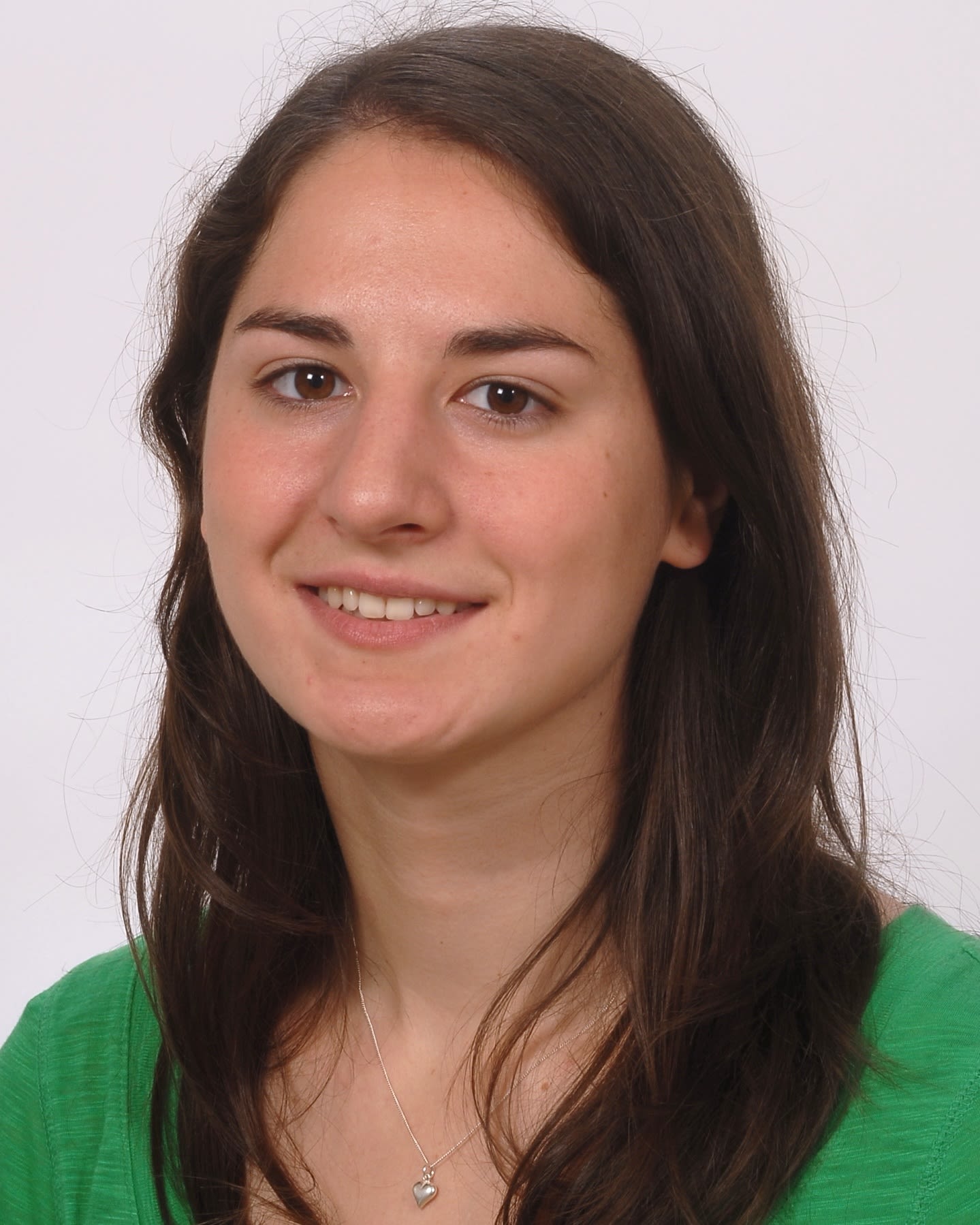
Jelena Brown (2023)
PhD in Chemical Engineering
Coming from Croatia, Jelena obtained a bachelor’s degree in chemical engineering from Villanova in the US and then a master’s from Cambridge back in 2014. After graduating, she worked in Kemsley Mill in Kent, the UK’s largest paper mill, participating in the start-up of a new wastewater treatment plant. Outside of studies Jelena is kept very busy with two young children, James (4) and Julia (1).
If you live in a hard water area, you’ve probably noticed white limescale deposits on your shower screen, around your sink, or inside your kettle. These chalky deposits are made of calcium carbonate, a substance that becomes less soluble as temperature increases and so it tends to build up on hot surfaces. This can be a big problem in heat pumps, where limescale clogs flow channels and reduces energy efficiency.
As heat pump technology evolves to use more eco-friendly refrigerants, the challenge of limescale is actually getting worse. The new refrigerants operate at higher temperatures, accelerating limescale buildup. My research focuses on understanding exactly where and why limescale forms by studying factors like temperature, water flow, and surface materials.
I’m also exploring ways to prevent or reduce these deposits, such as using a scale trap to catch limescale before it reaches critical components. By tackling this issue, my work aims to help heat pumps run more efficiently and last longer, thus supporting the transition to greener heating solutions.
Aliya Abdukadir Ali (2019)
PhD in Asian and Middle Eastern Studies
Aliya Ali recently completed her PhD in early Islamic history at the Faculty of Asian and Middle Eastern Studies. Her research examines political authority and governance during the first Islamic century, focusing on the leadership of Uthman b. Affan and Ali b. Abi Talib. Their leaderships marked a fundamental shift in the exercise of political authority and in emerging ideas of legitimacy, dissent, and governance within the early Muslim community.
Rather than viewing Uthman and Ali solely through later religious or sectarian narratives, my research approaches them as political actors operating within a complex matrix of tribal loyalties, familial alliances, and regional pressures. To better understand how they consolidated, and contested, authority, I adopt a data-driven methodology that is relatively new in this field. By constructing a biographical database of provincial governors and their networks, I offer a more systematic and concise view of elite political structures, which helps navigate the fragmented and often contradictory nature of early historical sources.
These sources, produced by early Muslim historians drawing on eyewitness accounts and oral reports, remain invaluable despite their inconsistencies. Through close analysis, my thesis reconstructs how Uthman and Ali negotiated power, responded to opposition, and shaped the political norms of their time.
Ultimately, this study sheds light on how the early caliphal period laid the foundations of Islamic political culture, foundations that continue to resonate across the Muslim world today.


Hannah Bazin (2024)
MPhil in Biological Sciences
Hannah grew up in Geneva, Switzerland, and studied Life Sciences Engineering at the Swiss Federal Institute of Technology (EPFL) with a year abroad at the Johns Hopkins University in the US. Outside of academic work, she loves to learn new vegan recipes and go running in the countryside.
Obesity affects over a billion people worldwide and one in four adults in the UK. It is a major risk factor for conditions like cardiovascular disease and places a heavy economic burden on healthcare systems. Yet current weight loss therapies fall short, with limited effectiveness and unwanted side effects.
My research aims to address this issue by studying brown adipose tissue (BAT), a type of fat in the body that regulates body temperature in cold conditions by burning calories. Having larger quantities and increased volumes of brown fat is linked to improved metabolic health and increased energy expenditure, suggesting that activating this tissue in obese patients could help them lose weight. The challenge lies in finding safe and effective ways to activate or grow brown fat in adults. To this end, I am using single-cell transcriptomics to study how brown fat cells (also called brown adipocytes) differentiate. By identifying key genes and pathways that drive this differentiation, I aim to uncover potential drug targets that could stimulate BAT formation. Ultimately, this could pave the way for new obesity treatments that work with the body’s own fat-burning mechanisms.
Brittany Bryant (2024)
MPhil Literature, Culture and Thought
Brittany is from Michigan, USA, and spent the last year in Italy as a Fulbright Research Fellow, investigating proposals for ‘inclusive language’ in Italian at the Università degli Studi di Enna “Kore” in Sicily. She loves Mandarin Chinese, ballet and the unique sounds of the willow ptarmigan bird.
My work explores sociolinguistics at the intersection of multilingualism, language ideologies, and mock or pseudo-linguistic forms. Mock language is an innovative linguistic system in which elements of one language are deliberately imitated and incorporated into another, often in distorted or exaggerated form. While frequently dismissed as linguistic play, they often reflect deeply ingrained language ideologies—i.e., our cultural system of ideas about social and linguistic relationships. I source examples from digital spaces, identifying text-based memes that feature mock language that contain potential stereotyping or conflations. My research aims to analyse the overt and covert features of these mock forms (hyperanglicisations/ foreignisations, morphosyntactic borrowing, metapragmatic awareness, self-referentiality, etc.) and examine how they reflect, reproduce, and circulate broader language ideologies.


 Built with Shorthand